The Ouroboros Resident
An essay on training, told in the shape of a circle. The serpent that eats its own tail is four thousand years old. I think it was always a drawing of residency.
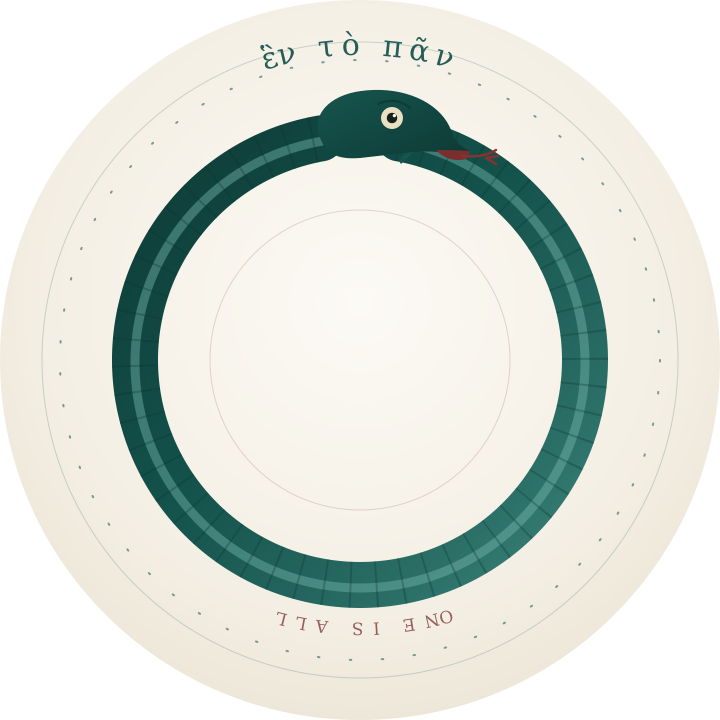
There is a symbol older than surgery, older than medicine itself: a serpent curled into a perfect circle, its jaws closed around its own tail. The Egyptians drew it on the walls of tombs. The Greek alchemists wrote beneath it, hen to pan, one is all. They called it the ouroboros, and they meant it as a riddle about eternity.
I think they were describing residency. They just didn’t have the vocabulary for it yet.
Let me tell you what I mean. And let me tell you the way I wish someone had told me, before July 1 of my intern year, when I stood in a freshly pressed white coat that fit my shoulders and absolutely nothing else about me.
I. The Swallowing
Here is the first thing nobody warns you about: you do not get a beginning.
You imagine residency starts at the start. It does not. You arrive mid-loop, mouth already closing on a tail you cannot see the end of. On day one, a nurse will page you about a patient you have never met, with a problem you have read about exactly once, and the word “Doctor” will be attached to your name like a borrowed coat. You will look around for the real doctor. There isn’t one. There is only you, and the loop, and the swallowing has already begun.
I remember my first overnight call with a clarity that I do not have for my own wedding. A post-operative patient, a falling blood pressure, a senior resident scrubbed into a case two floors away. I stood at the bedside and felt the precise weight of my own inadequacy, and I want to be honest with you about something, because honesty is the only currency that matters in this essay: I was not brave that night. I was terrified. I did the right things in the wrong order, with shaking hands, and the patient did fine, and I went into the stairwell afterward and sat down on a step and understood for the first time what I had signed up for.
I had signed up to be eaten.
Not by the hospital. Not by the hours, although the hours will try. I had signed up to be eaten by my future self. That is the deal nobody puts in the contract. Every competent version of you is built from the digested remains of an incompetent version of you, and the digestion is not optional, and it is not painless, and it is the entire point.
The medical student I had been, the one who finished near the top of his class, the one who thought knowledge was the same thing as readiness, that person died sometime in the first six weeks of intern year. I do not say this with drama. I say it the way an anatomist says it. He was consumed. And the thing that consumed him was the only thing that could have: the resident he was becoming.
II. The Anatomy of the Loop
If you are early in training, I want to give you something more useful than metaphor. I want to give you the mechanism, because once you see the mechanism, the suffering changes shape. It does not get smaller. But it gets meaningful, and meaningful suffering is survivable in a way that meaningless suffering is not.
Here is the loop, in four parts. You will travel it not once but thousands of times, at every scale, from a single suture to an entire career.
First, the mouth: exposure.You encounter the thing you cannot do. The anastomosis that leaks. The conversation about dying that you fumble. The diagnosis you miss because you anchored on the first plausible story. The mouth of the serpent is always open, and what it bites down on, always, is your own previous self. There is no other food. You cannot learn surgery from someone else’s hands. You can only learn it from the gap between what your hands did and what they should have done.
Second, the throat: the swallow.This is the part everyone wants to skip, and it is the part that cannot be skipped. The swallow is when you sit with the error. Not the public debrief, not the M&M presentation with its careful passive voice. The private reckoning, usually at two in the morning, usually in a car in a parking garage, when you replay the moment and feel the full weight of it. Trainees ask me how to get past this feeling. You do not get past it. You get through it, and the getting through is the swallow. A resident who deflects every error stays an intern forever, no matter what their badge says. The loop requires that you actually consume the failure, take it into yourself, claim it as yours.
Third, the body: digestion.This is the quiet miracle, and it happens mostly while you are not watching. The failure you swallowed gets broken down into something usable. The leaked anastomosis becomes an instinct about tissue tension that you cannot articulate but cannot ignore. The fumbled conversation becomes a pause you now take before delivering hard news, a breath that patients will never know was purchased with someone else’s grief. This is why the senior residents seem to have a sixth sense. It is not a sense. It is a stomach full of digested mistakes, metabolized into judgment. There is a name for this in the education literature, deliberate practice, and the name is accurate but bloodless. The truer name is what the alchemists wrote under their serpent: the work. The slow transmutation of base material into something that holds.
Fourth, the tail: renewal. And here is where the circle closes, where the symbol earns its shape. The new self, built from the digested old self, immediately becomes the tail. It gets bitten next. The PGY-2 who finally feels competent at floor management is fed to the PGY-3 who must learn the operating room. The chief who has mastered the service is fed to the fellow who knows nothing again. Every arrival is also an offering. The reward for completing a loop is a larger loop.
If that sounds like a punishment, stay with me, because the last movement of this essay is about why it is the opposite.
III. The Nested Serpents
Somewhere in the middle years, the geometry of the thing changes, and this is the part that took me longest to see.
You start residency believing you are a single snake eating a single tail. Your loop. Your growth. Your exhaustion, hoarded like a private possession. And then one July, without ceremony, a new intern looks at you the way you once looked at your seniors, with that particular expression of drowning politely, and you realize the truth: the ouroboros was never one serpent. It is serpents within serpents, loops nested inside loops, and you have just been promoted from being a mouth to also being food.
This is the moment training stops being about you, and paradoxically, it is the moment you start to become good.
Because here is what teaching does, and I say this as someone who once believed teaching was a tax on operating time: when you teach, you are forced to digest your own digestion. The instincts you built in the dark, the ones you could not articulate, must now be articulated, because a junior resident is holding the needle driver and looking at you and the tissue will not wait. You discover, in that moment, what you actually know versus what you merely do. The gap between those two things is enormous, and closing it is the second education, the one no curriculum lists.
The intern’s confusion feeds your clarity. Your clarity feeds the intern. Two serpents, each eating, each eaten, each better for it. The Egyptians drew one circle because papyrus is small. The real drawing would cover a wall: residents feeding fellows feeding attendings feeding the residents again, a hospital as a single braided organism that renews itself by consuming itself, every July, forever.
And somewhere in that braid is every patient you will ever touch. They are in the loop too. The patient who deteriorated on my first night call lives inside every resuscitation I have run since, and inside every resident I have taught to run one. He does not know this. He went home and resumed his life. But some essential fraction of him circulates through the system still, transmuted into vigilance, distributed across hands he never shook. If you want to know what medicine does with suffering, that is the honest answer. It does not erase suffering. It metabolizes it into protection for strangers.
IV. The Secret of the Closed Mouth
So now the ending, which, in keeping with our symbol, is not one.
There will come a day when you finish. A final case as a trainee, a certificate, a job, your name on a door. The calendar will tell you the circle is complete. And on that day I want you to remember the strangest detail of the ouroboros, the one that hides in plain sight: the serpent never lets go. In every drawing, across four thousand years, the jaws stay closed on the tail. The ancients could have drawn release. They never did.
They never did because release is not what the symbol means, and it is not what mastery means either. The belief that the loop has ended, that the eating is over, that one has finally arrived, is the quiet hazard of every career. The literature is plain about it; experience without continued deliberate practice does not just plateau, it decays. The only protection is to keep your own tail in your own mouth. To remain, voluntarily, a thing that consumes its former self.
I will tell you what that looks like in practice, because abstractions do not get anyone through a Wednesday. It looks like reviewing your own complications when no one requires it. It looks like asking the medical student what they saw, and meaning it, because fresh eyes catch what calloused ones skip. It looks like beginning again, as a fellow, as a new attending, as a person learning a technique that did not exist when you trained, and feeling the old intern terror rise in your chest, and greeting it this time like a colleague. Ah. You again. Good. The loop is intact.
Paul Kalanithi, who knew more than most about circles closing, wrote that the physician’s duty is not to stave off death but to take a patient and family into your arms until they can stand back up and face their existence. I would add only this, for those of us still inside the long middle of training: someone must also do that for the doctor. Mostly, it will be the loop itself. The structure of residency, brutal as it is, holds you the way the circle holds the serpent, in a shape that cannot fall apart because every part is gripping every other part.
You are being eaten. You are also doing the eating. Both are true, both are necessary, and neither will ever fully stop.
Hen to pan. One is all. The intern, the chief, the attending, the patient at two in the morning, the student watching from the corner of the room: one serpent, drawn in a circle, holding itself together with its own teeth. Welcome to the loop. It started before you arrived. It will continue after you leave. And for these few years, astonishingly, it is yours to carry forward.